Trainability gate: 5 circuit/rule/regime cells contain a training seed below 0.90.
Joint checkpoint gate: 3/16 checkpoints pass both validation accuracy ≥ 0.90 and the activity-quality gate; 4/16 pass the activity-quality gate alone. The activity gate requires resting rate ≤ 1 Hz, evaluated population rate ≤ 25 Hz, the q95 ceiling fraction ≤ 0.1, and the q5 participation ratio ≥ 0.2. Raw maxima and minima remain in model_profiles.csv so the quantile gate cannot hide outliers. This is a screening gate, not a claim of biological realism.
This is a supervised, non-RL factorial comparison. It crosses a dense capacity reference with degree-matched directed ring-lattice, small-world, and rewired-random recurrence, free-sign versus Dale-constrained recurrent outputs, current- versus conductance-based recurrent synapses, BPTT versus an explicitly approximate online e-prop-style learner, and fixed-step versus continuous-time tasks.
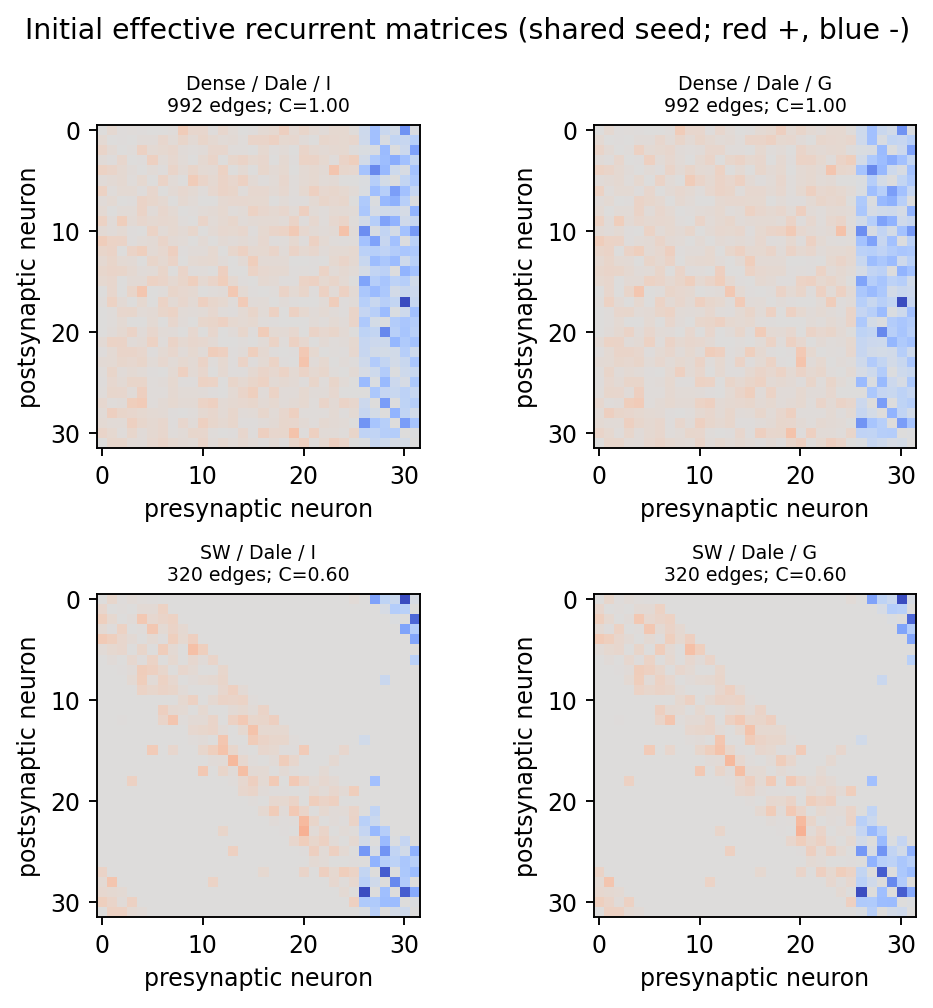
Task manifests, hidden size, ALIF constants, training budget, optimizer family, model seeds, and evaluation manifests are shared. The three sparse graphs have identical out-degree; dense intentionally remains a larger capacity reference. Distractor timing is randomized on matched schedules, and every frozen checkpoint is evaluated across an amplitude curve. Conductance circuits intentionally have two recurrent conductance states and voltage-dependent driving forces. Therefore wall time and state count are outcomes, not matched nuisance variables.
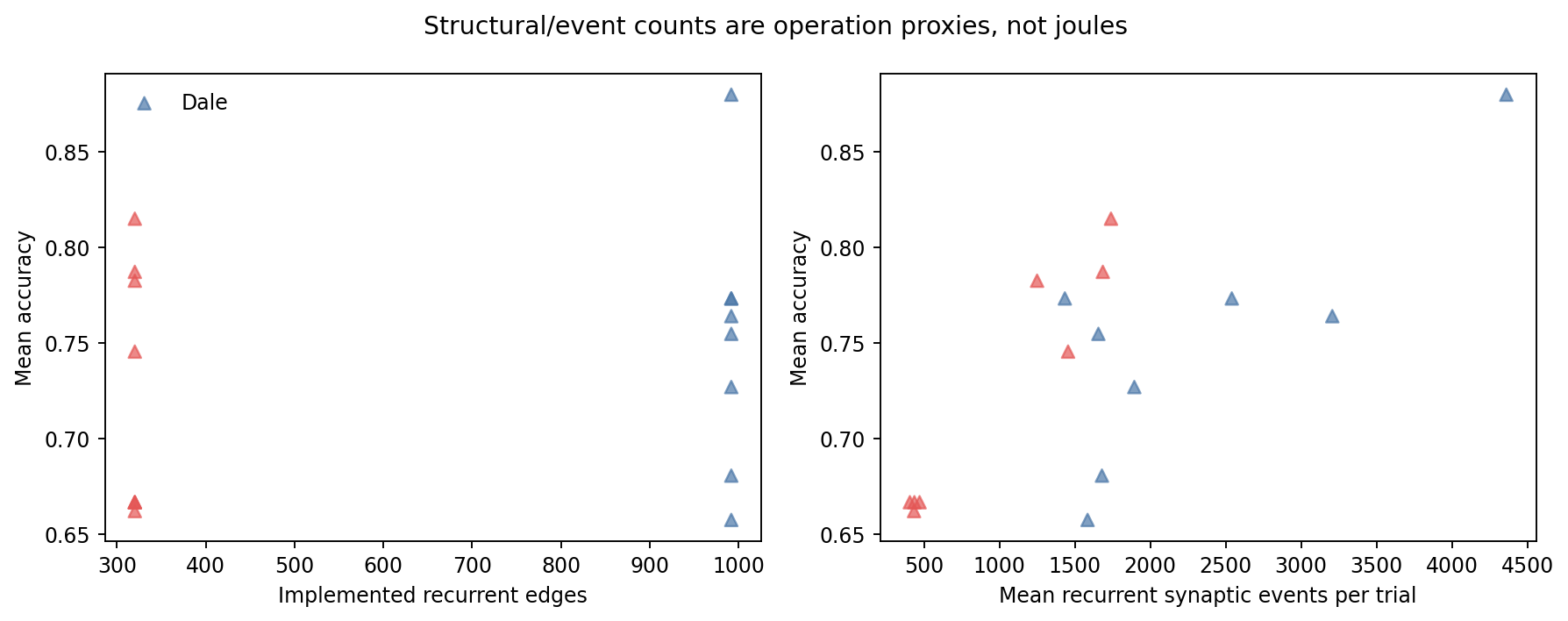
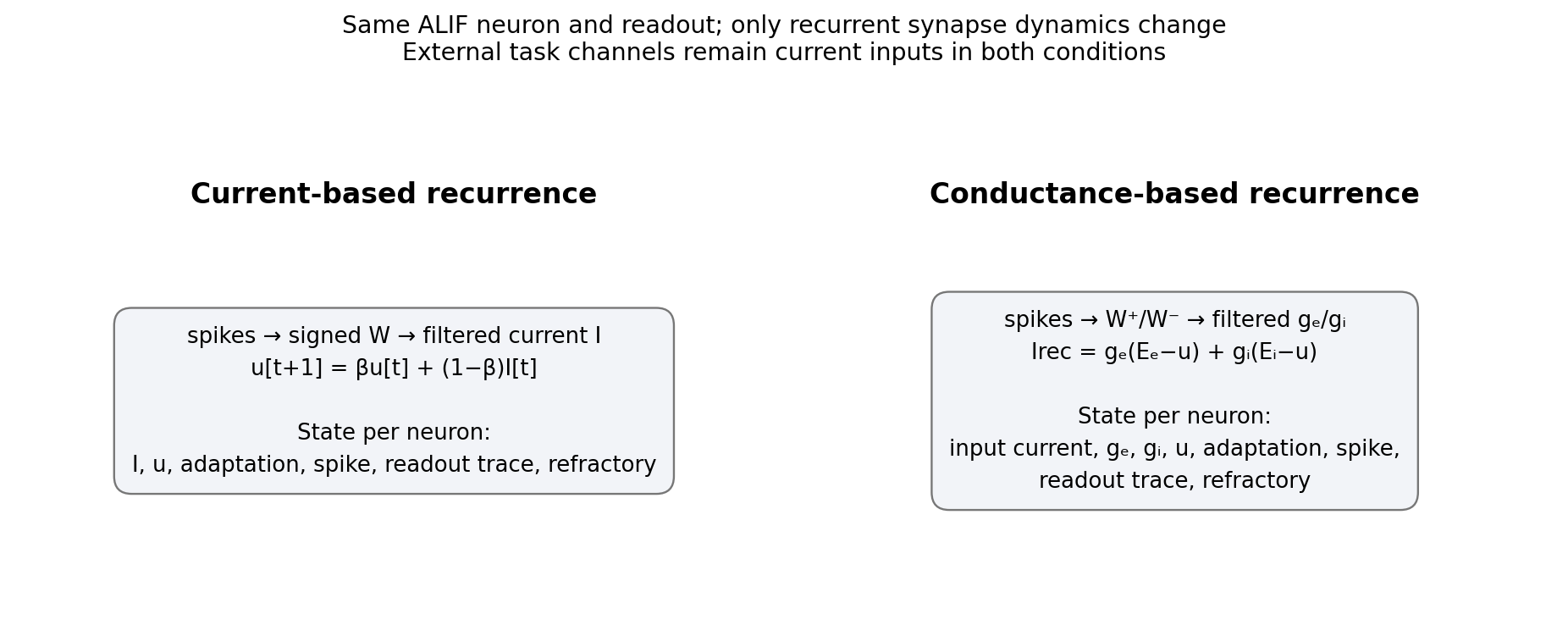
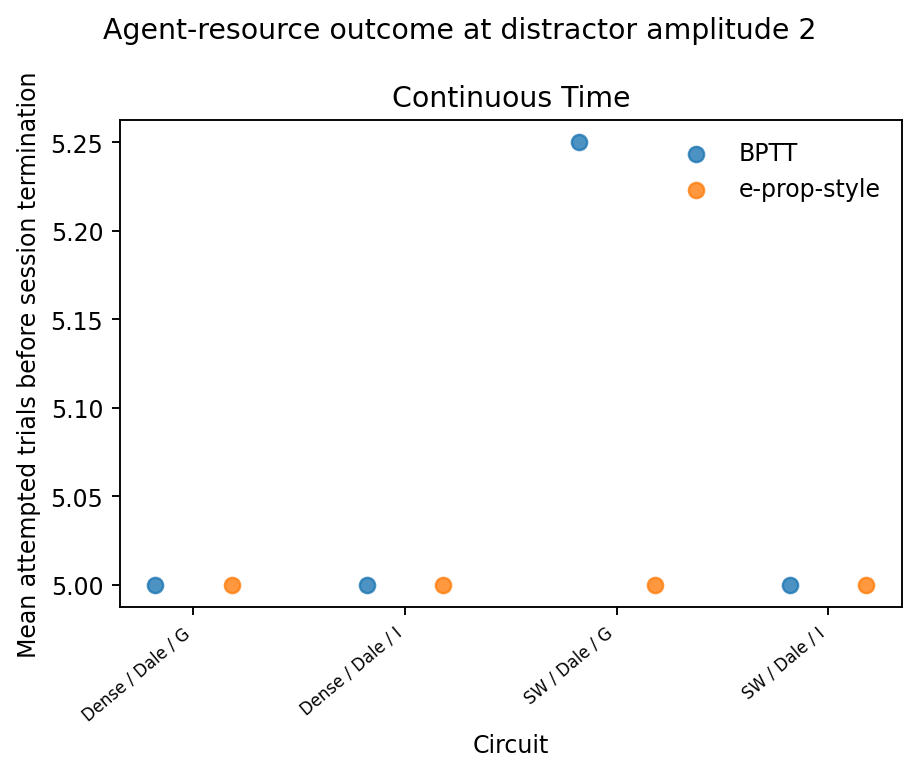
Interpretation limits: Small-world is a graph property, not a certificate of biological realism. Dale constrains recurrent outgoing signs but does not model cell types in full. The conductance condition applies to recurrence; external task channels remain current inputs. The local conductance eligibility derivative is a documented approximation. “Rewired-random” is the fully rewired endpoint of the same degree-preserving ring construction, not an Erdős–Rényi sample. Synaptic-event counts are logical graph-event proxies, not measured energy or a promise of sparse-kernel acceleration; the reference implementation uses dense tensor kernels. Agent energy is a secondary, externally specified resource ledger and is not coupled back into policy, sensing, or neural metabolism.
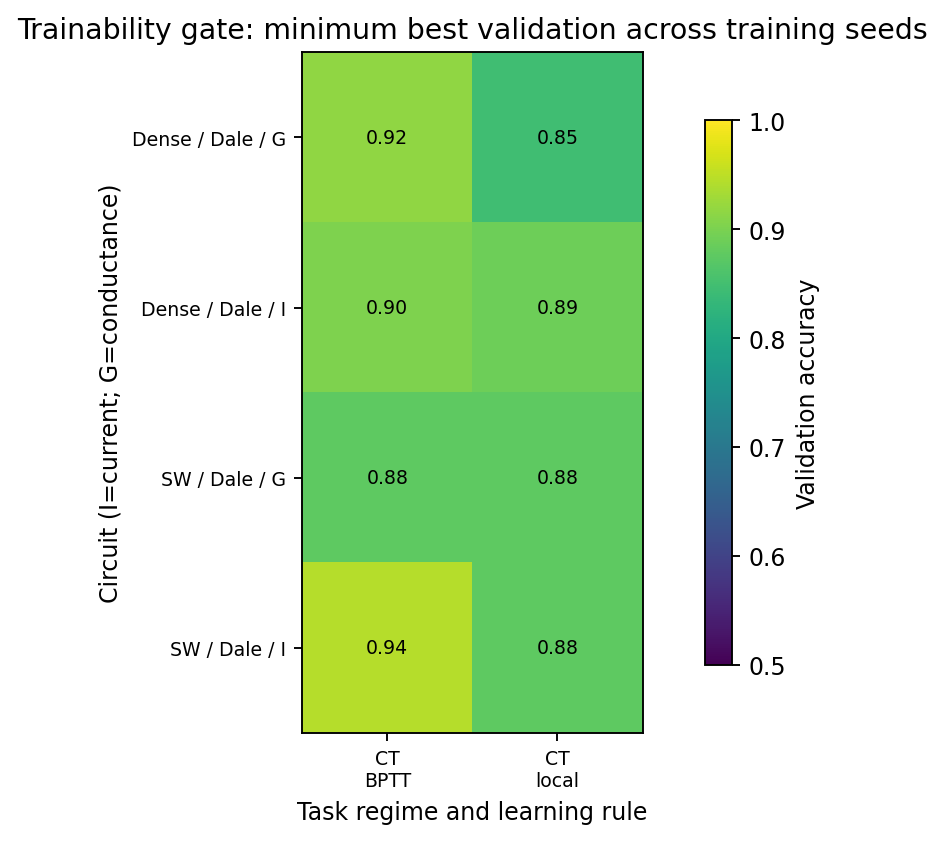
| circuit | task_regime | learning_rule | validation_mean | validation_min | training_seconds_mean | epochs_completed_mean | recurrent_edges | clustering | path_length | training_seeds | joint_gate_pass_fraction | physiology_gate_pass_fraction | resting_rate_hz_max | evaluated_population_rate_hz_max | evaluated_ceiling_fraction_max | evaluated_ceiling_gate_quantile_max | evaluated_participation_ratio_min | evaluated_participation_gate_quantile_min |
|---|---|---|---|---|---|---|---|---|---|---|---|---|---|---|---|---|---|---|
| Dense / Dale / G | continuous-time | BPTT | 0.951 | 0.917 | 3.892 | 107.0 | 992 | 1.000 | 1.000 | 2 | 0.5 | 0.5 | 0.0 | 16.840 | 0.500 | 0.438 | 0.031 | 0.387 |
| Dense / Dale / G | continuous-time | e-prop-style | 0.861 | 0.847 | 7.163 | 120.0 | 992 | 1.000 | 1.000 | 2 | 0.0 | 0.0 | 0.0 | 15.625 | 0.062 | 0.000 | 0.000 | 0.031 |
| Dense / Dale / I | continuous-time | BPTT | 0.917 | 0.903 | 3.026 | 103.0 | 992 | 1.000 | 1.000 | 2 | 0.5 | 0.5 | 0.0 | 13.765 | 0.250 | 0.188 | 0.031 | 0.435 |
| Dense / Dale / I | continuous-time | e-prop-style | 0.903 | 0.889 | 5.397 | 120.0 | 992 | 1.000 | 1.000 | 2 | 0.5 | 1.0 | 0.0 | 15.451 | 0.188 | 0.000 | 0.031 | 0.250 |
| SW / Dale / G | continuous-time | BPTT | 0.896 | 0.875 | 4.374 | 120.0 | 320 | 0.602 | 1.728 | 2 | 0.0 | 0.0 | 0.0 | 19.444 | 0.344 | 0.281 | 0.156 | 0.293 |
| SW / Dale / G | continuous-time | e-prop-style | 0.882 | 0.875 | 7.759 | 120.0 | 320 | 0.602 | 1.728 | 2 | 0.0 | 0.0 | 0.0 | 15.417 | 0.094 | 0.000 | 0.000 | 0.031 |
| SW / Dale / I | continuous-time | BPTT | 0.972 | 0.944 | 2.661 | 102.5 | 320 | 0.602 | 1.728 | 2 | 0.0 | 0.0 | 0.0 | 19.485 | 0.312 | 0.312 | 0.125 | 0.280 |
| SW / Dale / I | continuous-time | e-prop-style | 0.882 | 0.875 | 5.369 | 120.0 | 320 | 0.602 | 1.728 | 2 | 0.0 | 0.0 | 0.0 | 15.625 | 0.156 | 0.000 | 0.031 | 0.031 |
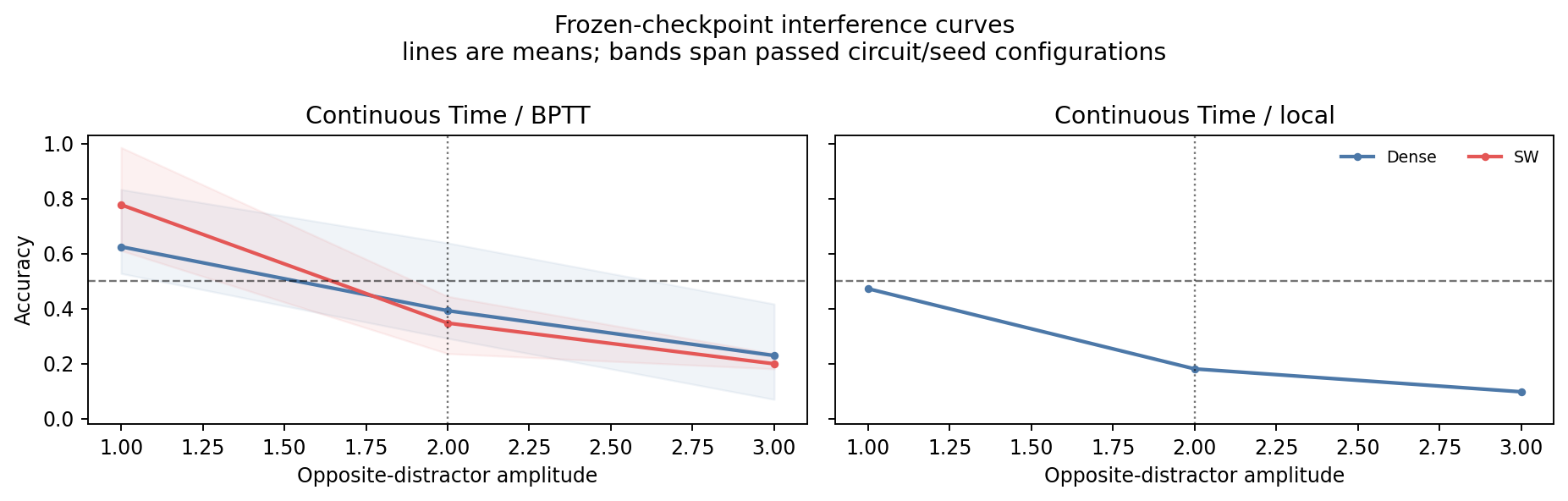
| topology | mean_accuracy | minimum_across_cells | maximum_across_cells |
|---|---|---|---|
| dense | 0.286 | 0.181 | 0.639 |
| small-world | 0.347 | 0.236 | 0.444 |
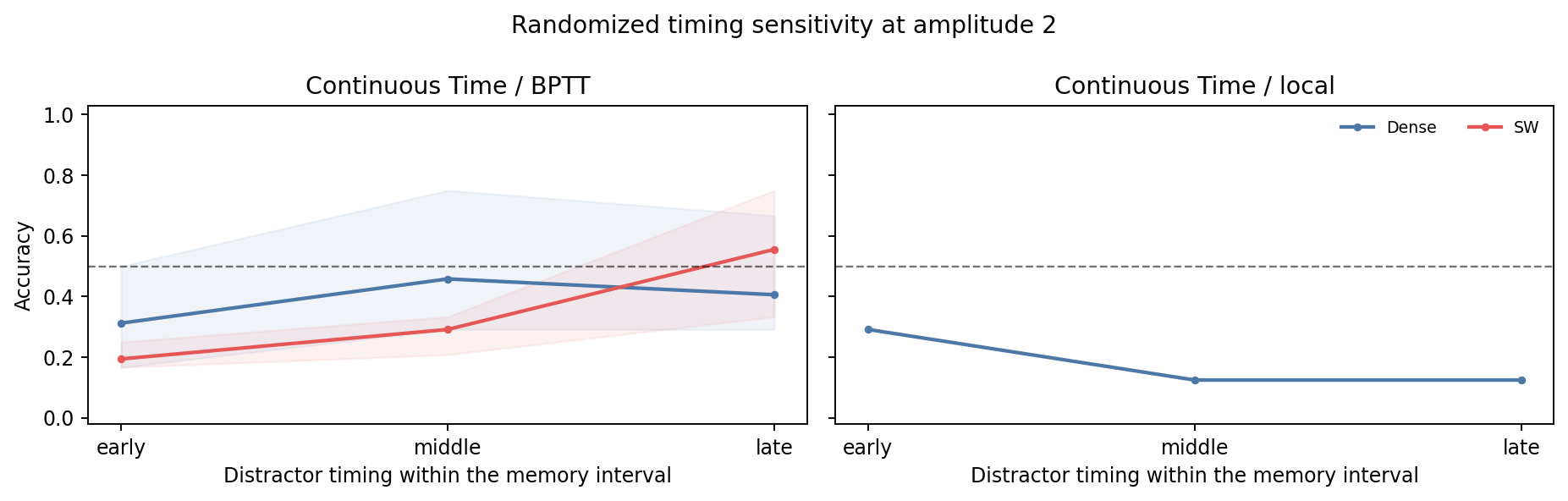
| topology | timing_bin | mean_accuracy |
|---|---|---|
| dense | early | 0.302 |
| dense | middle | 0.292 |
| dense | late | 0.266 |
| small-world | early | 0.194 |
| small-world | middle | 0.292 |
| small-world | late | 0.556 |
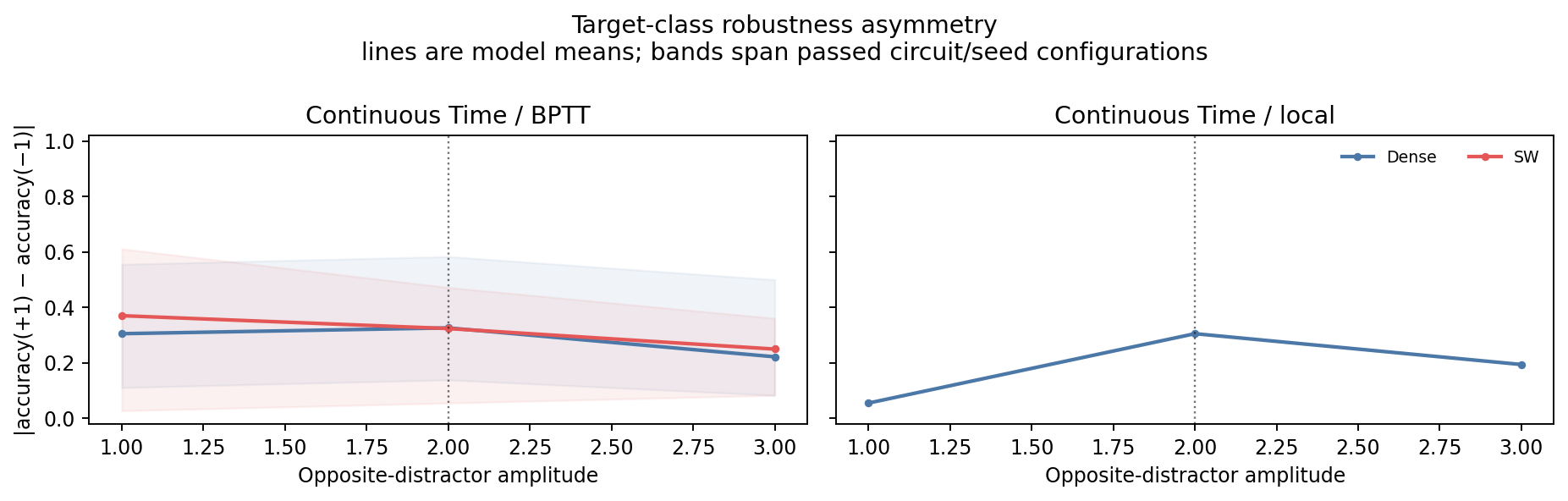
Overall accuracy can conceal a checkpoint that is robust for one cue direction and fails for the other. This view keeps the two balanced target classes separate and reports their absolute gap after first averaging matched evaluation manifests within a trained checkpoint. Inspect target_specific_behavior.csv and target_asymmetry.csv for the exact cells.
| topology | task_regime | learning_rule | accuracy_target_negative | accuracy_target_positive | mean_absolute_target_gap | maximum_absolute_target_gap |
|---|---|---|---|---|---|---|
| dense | continuous-time | BPTT | 0.375 | 0.410 | 0.326 | 0.611 |
| dense | continuous-time | e-prop-style | 0.333 | 0.028 | 0.306 | 0.389 |
| small-world | continuous-time | BPTT | 0.194 | 0.500 | 0.324 | 0.500 |
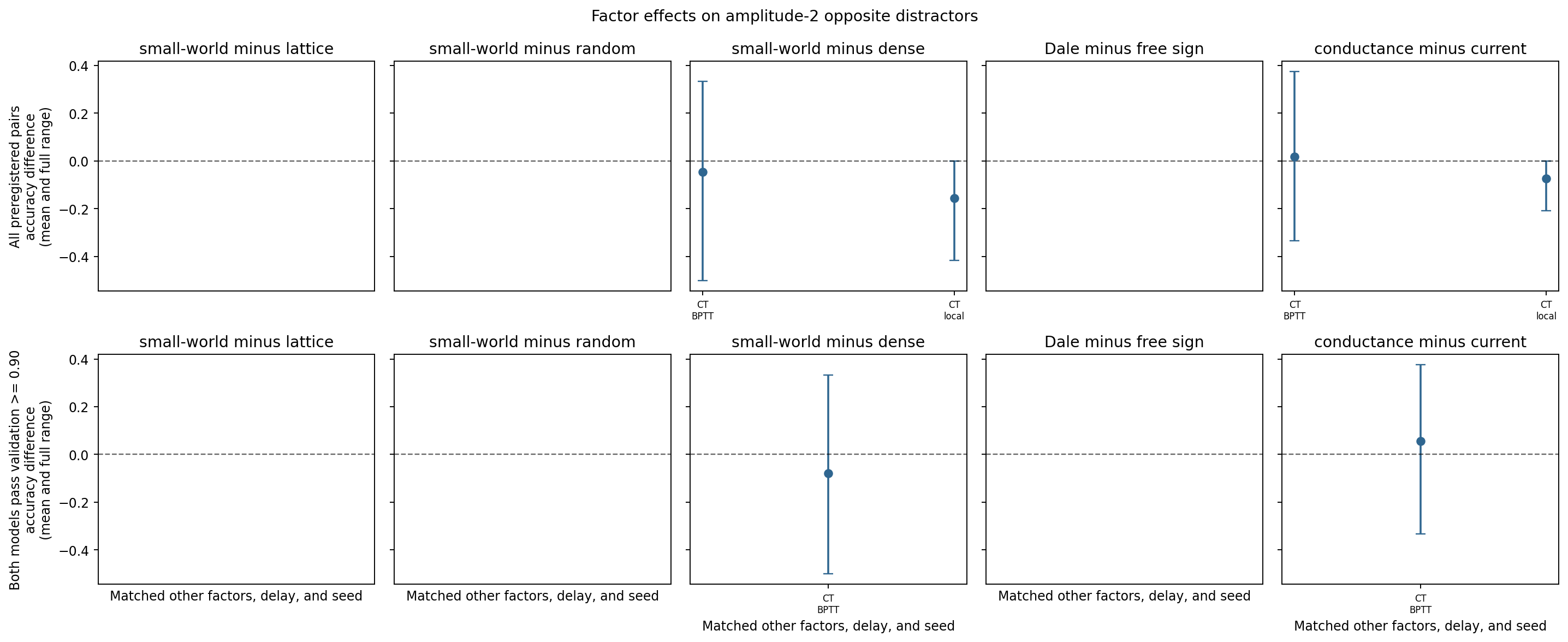
Evaluation manifests are averaged within a trained model before seed summaries. They are not counted as independent training replicates. The upper row preserves every preregistered pair; the lower row excludes a pair unless both models reached 0.90 validation accuracy. When the trainability gate has failures, behavioral factor effects are descriptive and the lower row is the necessary sensitivity analysis—not a license to hide the failed cells. Inspect paired_factor_contrasts.csv for every pairing and its validation flags.
| factor | task_regime | learning_rule | accuracy_high_minus_low |
|---|---|---|---|
| conductance minus current | continuous-time | BPTT | 0.056 |
| small-world minus dense | continuous-time | BPTT | -0.079 |
All raw tables, exact config, device benchmark, and reconstructable checkpoints are beside
this report. Re-run with python scripts/run_structural_ablation.py --config results/physiology/pilot-homeostatic-v1/config.json.
{
  "topologies": [
    "dense",
    "small-world"
  ],
  "dale_conditions": [
    true
  ],
  "synapse_types": [
    "current",
    "conductance"
  ],
  "learning_rules": [
    "BPTT",
    "e-prop-style"
  ],
  "task_regimes": [
    "continuous-time"
  ],
  "small_world_degree": 10,
  "rewiring_probability": 0.1,
  "excitatory_fraction": 0.8,
  "model_seeds": [
    11,
    23
  ],
  "evaluation_seeds": [
    101,
    211
  ],
  "evaluation_distractor_amplitudes": [
    1.0,
    2.0,
    3.0
  ],
  "primary_challenge_amplitude": 2.0,
  "activity_evaluation_amplitudes": [
    1.0,
    2.0,
    3.0
  ],
  "energy_evaluation_amplitudes": [
    2.0
  ],
  "hidden_dim": 32,
  "epochs": 120,
  "batch_size": 128,
  "bptt_learning_rate": 0.003,
  "eprop_learning_rate": 0.01,
  "perfect_validation_streak": 5,
  "train_trials_per_cell": 12,
  "validation_trials_per_cell": 4,
  "test_trials_per_cell": 6,
  "noise_std": 0.12,
  "dt_s": 0.01,
  "constant_bias_channel": false,
  "trainable_biases": false,
  "refractory_ms": 20.0,
  "adaptation_scale": 0.35,
  "tau_syn_ms": 20.0,
  "tau_mem_ms": 30.0,
  "tau_adapt_ms": 200.0,
  "tau_readout_ms": 100.0,
  "threshold": 0.2,
  "homeostatic_target_rate_hz": 8.0,
  "homeostatic_learning_rules": [
    "e-prop-style"
  ],
  "homeostatic_minimum_rate_hz": 1.0,
  "homeostatic_floor_weight": 1.0,
  "homeostatic_maximum_rate_hz": 20.0,
  "homeostatic_ceiling_weight": 8.5,
  "homeostatic_learning_rate": 0.005,
  "homeostatic_minimum_threshold": 0.01,
  "homeostatic_maximum_threshold": 0.8,
  "homeostatic_warmup_epochs": 20,
  "homeostatic_tolerance_hz": 8.0,
  "homeostatic_selection_minimum_accuracy": 0.9,
  "activity_regularization_weight": 0.2,
  "activity_ceiling_penalty_weight": 5.0,
  "activity_floor_penalty_weight": 1.0,
  "activity_participation_penalty_weight": 50.0,
  "activity_maximum_rate_hz": 20.0,
  "activity_minimum_population_rate_hz": 2.0,
  "activity_minimum_participation_ratio": 0.3,
  "maximum_population_rate_hz": 25.0,
  "maximum_ceiling_fraction": 0.1,
  "ceiling_quantile": 0.95,
  "maximum_resting_rate_hz": 1.0,
  "minimum_participation_ratio": 0.2,
  "participation_quantile": 0.05,
  "randomize_distractor_timing": true,
  "minimum_distractor_to_decision_steps": 1,
  "minimum_distractor_to_decision_s": 0.01,
  "device": "cpu",
  "energy": {
    "initial_energy": 0.8,
    "maximum_energy": 1.2,
    "basal_power": 0.55,
    "action_power": 1.4,
    "action_duration_s": 0.05,
    "replenish_power": 4.0,
    "replenish_duration_s": 0.18,
    "maximum_session_time_s": 30.0,
    "hard_step_cap": 10000
  }
}